
Some links in this article are affiliate links. If you buy through them, we may earn a commission at no extra cost to you. How this works.
Disclosure: This post contains affiliate links. If you buy through them, we may earn a small commission at no extra cost to you. We recommend products based on published specifications, the volume of real-world reviews, and how well they fit the specific problem. We have not hands-on tested every item; where an article is based on direct use, it says so.
Not sure how many bins fit your space? Try our free Storage Bin Calculator — enter your shelf or closet dimensions and see exactly how many bins fit, with the sizes that won’t work.
The Vertical Rule: Why Your Small Room Feels Full
Your small room doesn’t feel full because you own too much. It feels full because of what’s sitting at eye level.
The pattern shows up in almost every small studio: storage under the bed, storage in baskets, storage in every low corner — and the room still feels like it’s closing in. The floor is fine. The walls at chest height are the problem.
Here’s the rule that fixed it: everything above 5 feet should be visually quiet. Everything at and below eye level should be either useful or beautiful. Nothing else belongs there.
The 5-Foot Rule and the Eye-Level Band
Stand in your room. Look straight ahead. Now sweep your eyes from about 3 feet off the floor to about 6 feet. That’s the eye-level band. It’s roughly 36 inches to 72 inches.
This band carries almost all the visual weight in a room. Your brain reads it first. It’s where you see clutter, color clashes, and busy shapes without even trying. Everything below 3 feet reads as “floor” and your brain mostly ignores it. Everything above 6 feet reads as “ceiling zone” and fades into background.
The middle is different. The middle is loud.
Why the band matters more than square footage
Two rooms with identical dimensions can feel completely different based on what’s in that 3-to-6-foot strip. A room with a clean band and a messy floor feels open. A room with a tidy floor and a crowded band feels cramped.
The test is easy to run in one afternoon: clear the top of the dresser and the upper two shelves of the bookcase, and move nothing off the floor. The room reads as bigger almost immediately, and nothing about the actual storage has changed — only the band has.
If your room still feels tight after clearing the band, the problem is structural, not organizational. That’s a different fix, and it’s covered in why your small room feels smaller than it is.
Why Vertical Storage Usually Backfires
Every small-space article tells you to go vertical. Wall shelves. Ladder shelves. Pegboards. Floor-to-ceiling units. Store up, not out.
This advice is half right and mostly wrong.
Vertical storage adds capacity. It also adds visual noise at exactly the height where noise does the most damage. A wall of shelves from 2 feet to 7 feet puts 60 percent of its bulk right in your eye-level band. You gained 12 cubic feet of storage and lost the feeling of the room.
Ladder shelves are the worst offender
A ladder shelf is an open triangle of stuff. Five tiers, each one a different height, each one holding different objects in different colors. There’s no door, no lid, no visual break. It’s a display case you didn’t mean to build.
Put a ladder shelf in a 10×10 bedroom and the room shrinks. The shelf itself is only 18 inches wide. The visual footprint is the whole wall.
Pegboards do the same thing
Pegboards are great for a garage or a workshop. In a living space, a pegboard is a grid of small, high-contrast items hung at chest height. Every hook is a separate visual event. Twenty hooks means twenty things your eye has to process every time you walk in.
Wall-to-wall shelving stores more and feels worse
Open shelving at eye level is the single biggest reason small rooms feel full. You can fit more on it. You’ll also feel the room tighten every time you look at it. The trade is almost never worth it below 6 feet.
Closed storage at the same height does less damage because it hides the contents. But a wall of cabinet doors in a contrasting color still reads as mass. You’ve traded clutter noise for furniture noise.
The Inversion Fix
Flip the way you use height. Most people store low and display high. Do the opposite.
Below 3 feet: put the bulk here
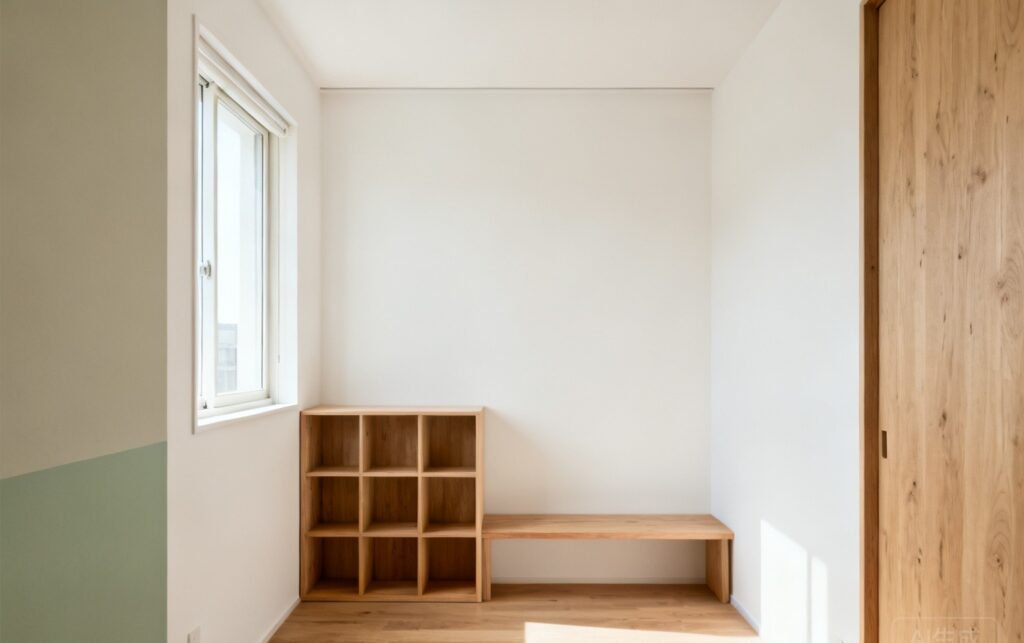
This is your storage zone. Beds with drawers underneath. Low benches with lift-up lids. Cabinets under 30 inches tall. Baskets on the floor. Anything heavy, bulky, or ugly goes here.
Your eye skips this zone. It reads as floor. You can stack it, fill it, and crowd it, and the room still feels open. A bed with 10 cubic feet of storage underneath costs you nothing visually.
3 to 6 feet: keep it clear, with one focal point
This is the hard part. Nothing goes in this band unless it’s used daily or you genuinely love looking at it.
One focal point per wall. A single piece of art. A mirror. One plant. A lamp. Pick one and let the rest of the band breathe.
Empty wall space at eye level is not wasted space. It’s the thing that makes the room feel bigger. Treat it like a resource.
Above 6 feet: same-color containers only
This is where you put the stuff you use twice a year. Holiday decorations. Off-season clothes. Old files. Spare bedding.
The catch: every container up there must match. Same color, same material, same shape if you can manage it. Mismatched bins above 6 feet read as clutter even though they’re out of your direct line of sight. Matching bins read as a single quiet mass.
Pick one color. Opaque white, matte black, or a warm gray. Buy enough to fill the whole run. Then never buy a different color again.
The shelves that clear the eye-level band can be renter-safe too — no studs, no drill: how to hang shelves in a rental.
What to Buy
Four things do most of the work. Buy them in this order.
- Matching opaque storage bins in a single color. Get the same brand and size for the whole top run. Opaque matters. Clear bins show contents and defeat the purpose. Expect $12 to $20 each.
- A low-profile storage bench under 20 inches tall. This is your 3-foot-zone workhorse. Lift-up lid, solid front, no visible clutter. $80 to $200 depending on width.
- A slim wall shelf under 8 inches deep for your one focal point. Depth is the enemy. Anything deeper than 8 inches starts to project into the room and reads as mass. $30 to $60.
- Floating cabinets for above 6 feet. Wall-mounted, closed, no legs. They read as part of the wall instead of furniture sitting in the room.
Skip ladder shelves. Skip pegboards in living areas. Skip open shelving below 6 feet unless you have fewer than 10 objects total to put on it.
The One Exception: Kitchens and Workspaces
Everything above is wrong in a kitchen.
In a kitchen, you need daily access to dozens of items at eye level. Spices, oils, knives, cutting boards, the pan you use four times a week. Putting those above 6 feet or below 3 feet makes the room unusable.
So the rule flips. In a kitchen or a workspace, vertical storage at eye level is correct. Open shelves, pegboards, magnetic strips, hanging rails. All of it works because the items are in constant use.
The difference is frequency, not aesthetics. A pegboard in a kitchen holds tools you touch every day. A pegboard in a bedroom holds decorative objects you touch never. Same object, opposite effect.
How to tell which room you’re in
Ask one question: is this thing touched at least five times a week?
If yes, it can live at eye level. If no, it goes up or down. That’s the whole test.
A home office is a hybrid. Your monitor, keyboard, and daily-use supplies stay at eye level. Books, files, and backup supplies go above 6 feet in matching boxes. Treat the desk zone as a kitchen and the rest of the room as a bedroom.
If the audit leaves you with a shopping list, buy from a ranked list rather than from whatever the algorithm shows first: small space essentials.
A 30-Minute Audit
Do this today. It takes half an hour and costs nothing.
Grab a notepad and a trash bag. Walk into the room and stand still.
Step 1: Mark the band
Find something 3 feet tall and something 6 feet tall. A chair back is usually around 36 inches. A door frame is 80 inches, so 72 inches is a bit below that. Use those as your rough markers.
Step 2: List everything in the band
Write down every object between 3 and 6 feet. Shelves, art, plants, boxes, lamps, electronics, hooks, everything. Be honest. Most people find 15 to 30 items.
Step 3: Sort into three piles
- Used daily: stays. Phone charger, lamp, the book you’re reading.
- Loved: stays, but only one per wall. The print you actually look at. The plant that’s still alive.
- Neither: goes up above 6 feet or down below 3 feet. Most of the list lands here.
Step 4: Move the “neither” pile
Relocate, don’t reorganize. A box that moves from a shelf to under the bed is a win. A box that gets rearranged on the same shelf is not.
Step 5: Step back and look
The room will feel different. Not because you removed things, but because you moved them out of the band your eye reads first.
Do this once and the effect lasts about three months. Then clutter creeps back into the band, because that’s where your hands naturally put things. Re-run the audit quarterly. It takes 10 minutes the second time.
The floor was never the problem. The middle of the wall was.