
Some links in this article are affiliate links. If you buy through them, we may earn a commission at no extra cost to you. How this works.
Disclosure: This post contains affiliate links. If you buy through them, we may earn a small commission at no extra cost to you. We recommend products based on published specifications, the volume of real-world reviews, and how well they fit the specific problem. We have not hands-on tested every item; where an article is based on direct use, it says so.
Why This Question Keeps Coming Up
A 60-square-foot corner that has to serve as office, dining overflow, and bike storage is not unusual in a small apartment. What is unusual is how badly most foldable desk advice answers it. Reviews tend to describe the product in isolation, which is the wrong unit — a foldable desk only works or fails as part of a corner: desk plus chair plus where you put your cables plus where the chair goes when the desk is down.
This piece works the other way around. It starts from what each type of foldable desk actually is in mechanical terms, what it demands of the room, and what tends to go wrong in practice based on the failure patterns in user reviews. Where a number appears, it comes from a manufacturer spec or a widely reported user measurement — not from a single desk we bought.
The short version: foldable desks work, but only if you match the type to how many hours a day you actually sit there. Most people buy the wrong type and blame the desk.
If the constraint is the lease rather than the desk, the same reversibility logic applies to every other change in the apartment: eight changes you can undo in a weekend.
The Three Types, and What Each Demands
1. Wall-mounted drop-leaf desk
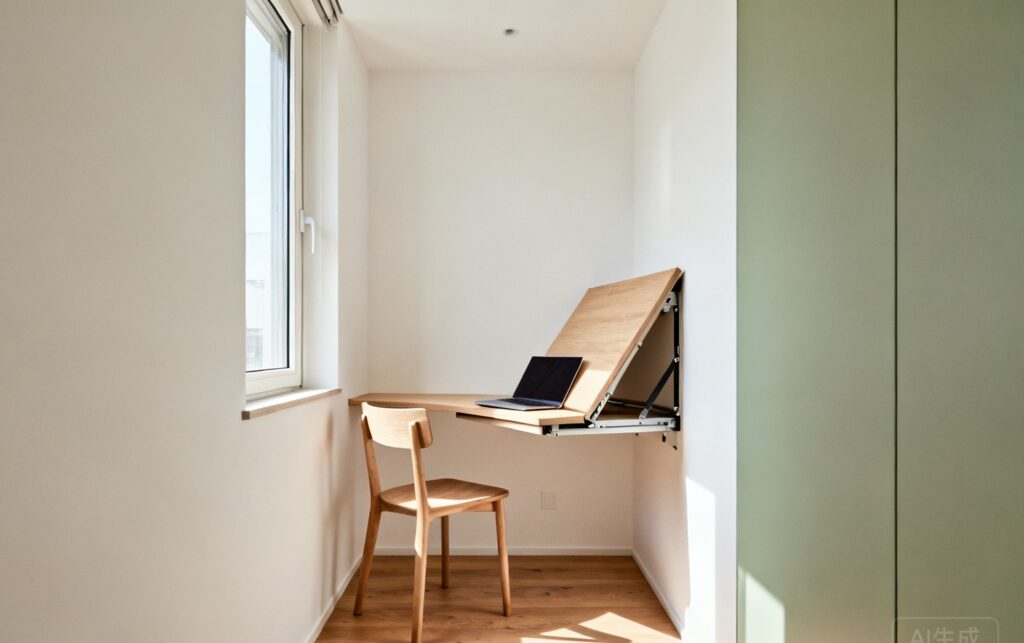
A panel that hinges off the wall. It folds down flat, usually 3 to 5 inches deep, and swings up to a working surface of 30 to 42 inches wide and 18 to 20 inches deep.
What works: It genuinely disappears. Folded, it reads as a shelf. The wall carries the load, so there are no legs to kick and nothing wobbling underneath. Mount the surface at 29 inches for someone 5’8″ to 6’0″ — that is standard desk height and the most common source of shoulder strain when it is wrong.
What fails: The install is the whole story. This needs studs, or proper toggle bolts into drywall rated for 100+ pounds. Renters with a strict landlord have a real conversation ahead. And the bracket arms occupy wall space below the desk, so a cabinet cannot sit flush against it.
If you have the wall, this is the shape to buy: Tangkula 31.5″ Wall Mounted Folding Desk — about $60, ★4.3, 900+ ratings. A 31.5-inch floating panel that folds flat against the wall. At under $60 it is the cheapest way to test whether a drop-leaf works in your corner before spending on the larger 37-inch units.
If you want the bigger surface: MM MELISEN Wall Mounted Folding Table, 37.4 × 21.6 in — about $140, ★4.2. The 37-inch width is the difference between a laptop-only desk and one that takes a laptop plus a monitor. It is also twice the price and needs a wider clear wall.
Verdict: The best option for 2 to 4 hours of daily use in a tight footprint — if your walls are yours to drill into, or your landlord will agree to it in writing.
2. Freestanding folding table with legs
A 31 × 20 inch top on folding X-legs, usually $40 to $90, typically 10–12 pounds, folding to about 2.5 inches thick.
What works: Cheap, fast to set up, movable. It doubles as a dining table when guests come over.
What fails: Lateral stability. At 31 inches wide, X-legs flex the moment you lean your forearms on the front edge. Typing is fine; leaning in to read a document is not. And folded, you still have to store a 31-inch slab somewhere. “Folds flat” and “disappears” are different promises.
Verdict: Fine for occasional use, meals, and craft projects. Not an 8-hour desk.
The freestanding table worth buying: GreenForest Folding Desk, No Assembly — about $70, ★4.7, 13,000+ ratings. The highest rating volume in this category, and “no assembly” is not marketing here: it unfolds. ★4.7 across 13,000 buyers is the strongest evidence available in a product class with no independent lab testing.
The cheapest that still holds a laptop: Furinno Riau Folding Metal Frame Desk — about $29, ★4.0, 33,000+ ratings. Twice the review volume of anything else here, and the lowest rating of the group. Read the one-star reviews first: the complaints are consistent and they are about the same thing, which tells you the failure mode rather than a random defect.
3. Folding desk that converts from a shelf or cabinet
A wall unit or freestanding cabinet where the front panel drops down into a work surface, sometimes with internal storage for a laptop and cables.
What works: Storage plus surface in one footprint. If there is literally no floor space and no wall worth dedicating, this is the only option that gives both.
What fails: Depth. Most give 16 to 18 inches of working depth, and the hinge mechanism eats another inch or two. That covers a laptop and a mouse. It does not cover a laptop plus a monitor plus a notebook. The mechanism also adds weight and cost — units in this class commonly run 40–50 pounds and $200–300.
Verdict: Worth it only if storage is the primary problem and you work laptop-only. Otherwise the drop-leaf beats it on every axis.
What Actually Goes Wrong
Generic warnings like “it was a bit wobbly” are useless. These four problems are specific and predictable, and they show up repeatedly in reviews of every type in this category.
The wobble threshold. Freestanding folding tables in this size class typically start to shake under roughly 8 pounds of downward pressure on the front edge — about the weight of both forearms resting while you lean forward. Below that they are stable. Above it, a monitor on the same table sways visibly. Wall-mounted drop-leaves do not have this failure mode at all, because the wall takes the load.
The cable management disaster. This is the part nobody warns you about. Every time the desk folds, the charger, monitor cable and mouse have to be unplugged or reorganized. Leaving everything plugged in and folding anyway works for a while, then crimps a USB-C cable. The fix is a cable tray mounted to the wall above the fold line, with a single slack loop that lets the desk move without stressing anything. That is the only arrangement that holds up.
The “where does the chair go” problem. A folded desk takes almost no space. A chair takes a lot — a typical office chair is 24 inches wide and 24 inches deep. When the desk folds, the chair has nowhere to go except the middle of the room. If the chair does not fold or tuck, you have solved half the problem and created a new one. A folding chair that hangs on a hook is often what makes the corner work.
The collapse ritual. The entire surface has to be clear before folding. Every time. Laptop, mouse, notebook, coffee cup, the pen left there. There is no shortcut, and a mug left standing is exactly how people learn it. Budget 60 to 90 seconds for the clear-and-fold routine, twice a day, and decide before buying whether you will actually do that.
If the ritual sounds exhausting, that is useful information. It means you want a desk that stays up. See how to make a small room feel bigger for the layout tricks that buy you that permanent inch.
The Three Measurements That Decide It
Before buying anything, measure these three things and write them down. Most foldable desk returns trace back to skipping this step.
Seated elbow height. Sit in the actual chair, feet flat, shoulders relaxed, arms hanging. Measure from the floor to the bottom of the elbow. That number is the ideal desk surface height. For most adults it lands between 26 and 30 inches, and standard desks are 29 to 30 inches. If the number is 26, a standard-height desk will make the shoulders creep up all day. Adjust chair height first, then buy the desk.
Chair pull-out depth. Measure the chair’s depth front to back, then add 4 inches of knee clearance. A 24-inch-deep chair needs a desk that sits at least 28 inches from the wall behind it, or you end up sitting sideways. This is the number that kills most drop-leaf plans: a 20-inch-deep drop-leaf plus a 24-inch chair does not fit in a 40-inch nook.
Push-back clearance. Standing up means pushing the chair back first. That needs 12 to 18 inches of clear floor behind the chair. Without it, you stand up by sliding sideways out of the chair, which gets old by week two. Measure from the back of the chair to whatever is behind it. Under 12 inches means you need a different chair, not a different desk.
Total floor depth needed: chair depth + 4 inches knee room + 12 inches push-back. For a typical setup that is about 40 inches. If you have 40 inches of depth and 36 inches of width, stop reading foldable desk reviews and buy a small permanent desk.
Verdict, by Use Case
No hedging.
8 hours a day, every day: Do not buy a foldable desk. The clear-and-fold ritual will break you by week three, and the flex on freestanding models will annoy you daily. Buy the smallest permanent desk that fits. A 36-inch-wide, 20-inch-deep desk with a single drawer beats every foldable option here.
2 to 3 hours a day: The wall-mounted drop-leaf wins. Stable, it disappears, and the ritual is short enough to tolerate twice a day. This is the sweet spot for the category.
Occasional use, under an hour, a few times a week: The freestanding folding table is fine. Cheap, portable, and you will not lean on it long enough to notice the flex.
The convertible shelf-desk: the one to skip. Most expensive, shallowest, heaviest, and it only wins if storage is the single biggest constraint.
The desk is only half the problem: everything that would normally live on it or under it needs a home too. Clamps and adhesive mounts that lift the cables, the tower and a drawer off the floor are compared in no-drill under-desk storage mounts.
What to Look For
Four things make a small corner work. The desk and the chair are the two that matter most.
Wall-mounted drop-leaf desk, 36-inch — steel bracket arms rated for 100+ pounds, and a surface depth of at least 18 inches. The arms and the depth rating are what separate a real drop-leaf from a decorative shelf.
Compact folding table, 31 × 20 inch — a locking leg mechanism, not just friction hinges. The lock is the difference between “a bit of flex” and “the monitor swaying.”
Folding chair that stores flat — under 3 inches thick folded, and hang it on a wall hook. This solves the “where does the chair go” problem completely.
Under-desk cable management tray — mounted to the wall above the fold line, not to the desk itself. One slack loop, everything else stays put when the desk folds.
What Most People Get Wrong
The common mistake is buying the desk first and discovering the chair and cable problems afterwards.
In practice the drop-leaf is the only type that holds up over months of daily use, and it holds up because of what surrounds it: a folding chair that hangs on a hook, and a cable tray mounted to the wall rather than the desk. The desk alone solves maybe 60 percent of the problem.
And if there are 36 inches of width to spare, a permanent small desk is the better purchase and the foldable category becomes irrelevant. A 36 × 20 inch desk with a single drawer takes up less usable floor than most people expect, because the chair is not constantly being moved out of the way. The foldable category exists to solve one specific problem. If that is not your problem, do not buy into it.
Measure the corner first. 40 inches of depth and 36 inches of width means buy the permanent desk. If not, buy the drop-leaf and a chair that hangs on a hook. Skip everything in between.