
Some links in this article are affiliate links. If you buy through them, we may earn a commission at no extra cost to you. How this works.
Every studio apartment has the same complaint: it feels like one room. That’s because it is one room. But the feeling of “one room” isn’t caused by square footage. A 400-square-foot studio and a 400-square-foot one-bedroom can have identical floor area, and the one-bedroom will feel twice as large. The difference is sightlines.
Stand in your studio and look at the layout. Your eye can probably travel from the front door to the back wall without hitting anything solid. That single unbroken sweep is what your brain reads as “one box.” Fix the sightlines and the apartment starts reading as two spaces, even though no wall moved.
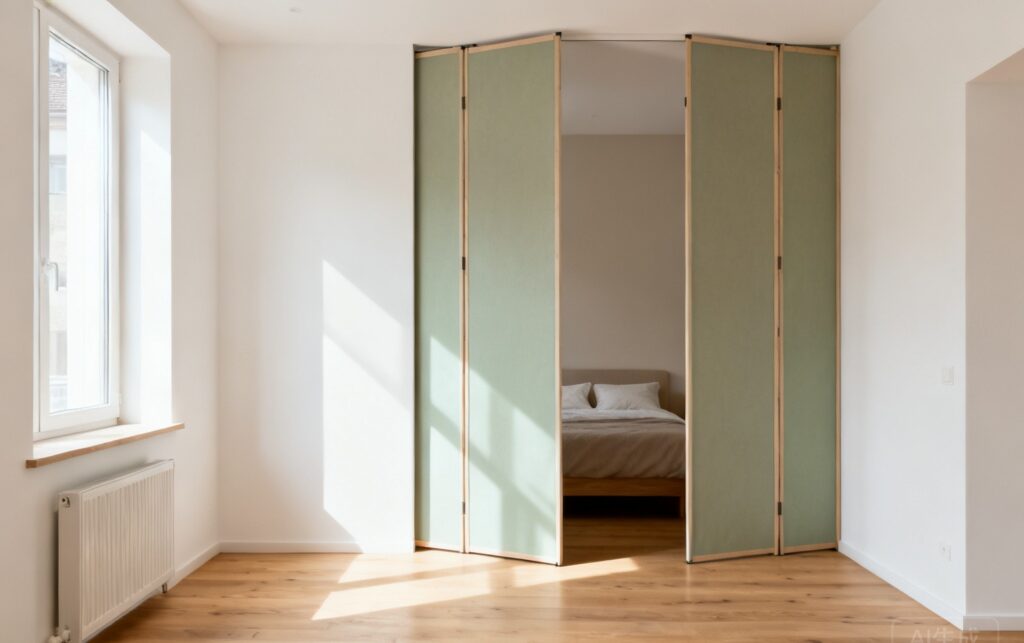
If you rent, you can’t build that wall. But you can put something in the sightline that comes down in ten minutes and leaves no holes. Here are six renter-friendly options, with real weight limits and prices.
Disclosure: This post contains affiliate links. If you buy through them, we may earn a small commission at no extra cost to you. We recommend products based on published specifications, the volume of real-world reviews, and how well they fit the specific problem. We have not hands-on tested every item; where an article is based on direct use, it says so.
The short answer
| Method | Holds up to | Price | Install time |
|---|---|---|---|
| Floor-to-ceiling tension rod + curtain | 10 ft height | $28 | 10 min, zero tools |
| Blackout curtain on existing track | — | $18-35 | 5 min |
| Freestanding folding screen (3 panel) | 6 ft tall | $50 | 2 min, no install |
| Portable 2-panel partition | 142″ wide | $70 | 2 min |
| Ceiling-track curtain | 8.3 x 7 ft | $35 | 20 min |
| 4-6 panel folding divider | 11 ft wide | $55-70 | 5 min |
1. Floor-to-Ceiling Tension Rod + Curtain — the most flexible
Pick: No-Drill Curtain Rod Wall Divider, adjustable 4-10 ft — $28.48, ★4.4, 1,900 reviews
This is a tension rod that wedges between floor and ceiling with rubber pads. No screws, no brackets, no wall damage. Hang a curtain from it and you have a soft wall that disappears when you want the space open.
Why it works: adjustable from 4 to 10 feet high and 28 to 70 inches wide, so it fits almost any studio ceiling. It’s the only method here that works in a room with a sloped or textured ceiling, because tension doesn’t care about drywall.
The catch: tension rods need a solid ceiling and floor. On a drop ceiling or thick carpet, they slip. Test by pressing hard before you trust it with a heavy curtain.
Also consider: the same rod in a longer length — $28.48, ★4.4
2. Blackout Curtain (on a track or existing rod) — the cheapest
Picks:
- RYB HOME Blackout Room Divider Curtain — $17.99, ★4.7, 2,600 reviews
- Total Blackout Privacy Curtain, 8.3 x 7 ft — $34.98, ★4.5, 1,000 reviews
A single wide blackout curtain hung from ceiling to floor reads as a wall from across the room. It also kills sound and light between the two zones, which matters more than you think when one side is a bedroom.
Why 4.7 stars across 2,600 reviews: the RYB HOME panel is the highest-rated item in this entire category. Thermal insulation is a real side benefit — it blocks heat transfer between zones.
The catch: you need something to hang it from. If you have no track, pair it with the tension rod above (option 1).
3. Freestanding Folding Screen — no installation at all
Pick: RANTILA 3-Panel Folding Room Divider, 6 ft tall — $49.99, ★4.3, 1,900 reviews
This folds out like an accordion and stands on its own. The 3-panel version is 102″ wide — enough to block a sightline from the entry to the living area — and 71″ tall, which is above eye level when seated.
Why it’s the safest option: it involves no adhesive, no tension, and no wall contact. There is nothing that can fail or damage anything. If your lease says nothing on the walls, this is the only option on this list that literally touches no wall.
The catch: it’s freestanding, so it can be knocked over. Reviews mention this with pets and small children. The 6-panel version below is more stable.
Also consider:
- VEVOR 4-Panel, 136″ wide — $54.81, ★4.5, 714 reviews
- VEVOR 6-Panel — $69.90, ★4.5, 714 reviews
4. Portable 2-Panel Partition — for people who rearrange often
Pick: Rantila 2 Large Panels, 142″ wide — $69.99, ★4.3, 1,600 reviews
Two large panels on a folding hinge. At 142 inches wide it covers more ground than the 3-panel version, and because it folds flat you can store it behind a door when guests come.
Use it for: creating a temporary office during work hours and folding it away at night. This is the option for people who want the divider to exist only sometimes.
Nothing about a 400-square-foot studio is decided by square footage — it is sightlines and light. If the divider is the first change you make, read why a small room reads small before you buy anything.
5. Ceiling-Track Curtain — the closest thing to a real wall
Pick: Flexible Ceiling Track Room Divider Curtains — $44.99, ★4.3, 1,200 reviews
A flexible track mounts to the ceiling and the curtain slides along it, including around corners. This is the only method that can divide an L-shaped space or follow a curved path.
The catch: the track does require screws into the ceiling. If your lease allows ceiling fixings (many do — they’re rarely checked and easily spackled), this gives the most wall-like result.
If the divider is really for light control rather than privacy, the blackout options use the same tension-rod mounting: no-drill blackout curtains.
Choosing in 30 seconds
- Nothing may touch the wall → folding screen (option 3)
- Sloped or textured ceiling → tension rod (option 1)
- Want it to vanish sometimes → portable partition (option 4)
- Need sound and light separation → blackout curtain (option 2)
- Odd-shaped room or corner → ceiling track (option 5)
The 60% rule is a zoning idea, not a hardware idea — it is the same reasoning behind turning one studio into two rooms.
The 60% rule that makes any divider work
Whatever you pick, keep it under 60% of ceiling height for the first third of the room nearest the entry. A divider that goes floor-to-ceiling right at the door makes a studio feel like a corridor. Let the eye travel over the top of the divider near the entry, then go full height deeper in the room where it actually separates the sleeping zone.
That single adjustment is the difference between “the apartment feels bigger” and “the apartment feels like a hallway.”
One thing to test before you buy
Measure your ceiling height at the exact spot you plan to install. Tension rods need a flat surface at both ends. If your ceiling is more than an inch higher on one side of the room, the rod won’t hold. A laser measure ($17-20) pays for itself the first time it saves you a return shipping label.
Disclosure: This post contains affiliate links. If you buy through them, we may earn a small commission at no extra cost to you.