
Some links in this article are affiliate links. If you buy through them, we may earn a commission at no extra cost to you. How this works.
Some links in this article are affiliate links. If you buy through them, we may earn a commission at no extra cost to you. How this works.
Most small rooms don’t feel small because of square footage. They feel small because of visual noise.
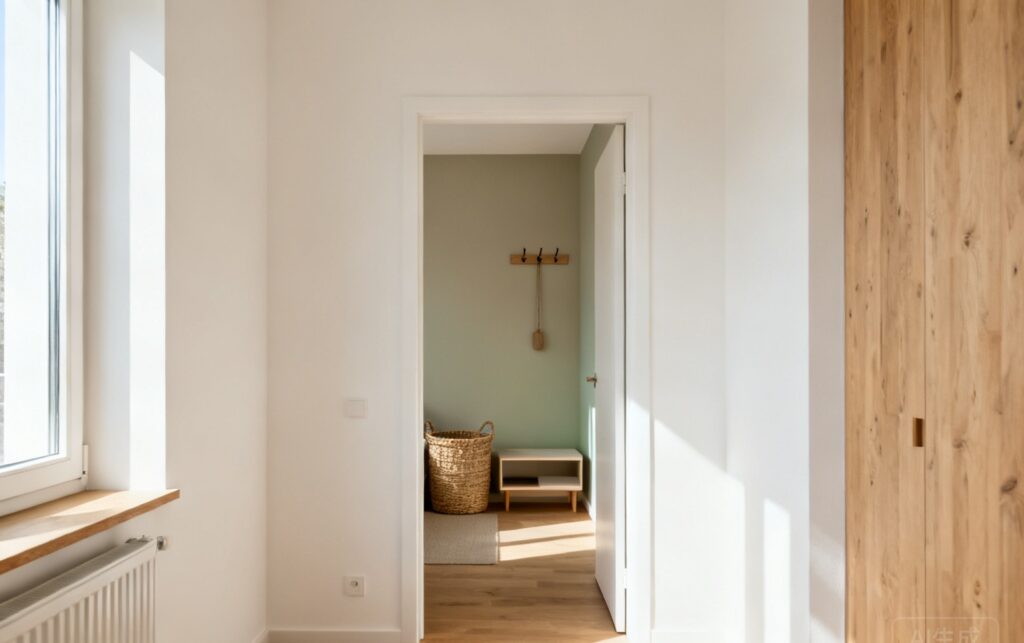
Here is the test: stand in the doorway and count how many distinct objects your eye lands on. Ten or more means the room is fighting itself. Six or fewer means it is working.
That test is the whole article in one sentence. Everything below is a way to get the count down — three fixes cost nothing, and five are worth a small purchase if the first three aren’t enough.
Disclosure: This post contains affiliate links. If you buy through them, we may earn a small commission at no extra cost to you. We recommend products based on published specifications, the volume of real-world reviews, and how well they fit the specific problem. We have not hands-on tested every item; where an article is based on direct use, it says so.
Why a small room reads as small
Three things do almost all of the damage, and none of them is the floor plan.
Your sightline gets chopped. One tall bookcase breaks the back wall into two narrow strips. Two tall pieces break it into three. Your eye reads “several small rooms” instead of one continuous space, and the room shrinks in your head before you’ve measured anything.
The corners are dark. A dark corner is a place your eye stops. Rooms that feel bigger are usually just rooms where light reaches the back wall — which is why a $75 lamp often beats repainting.
Surfaces are covered. Every horizontal surface that is full reads as floor you can’t use: the desk, the dresser top, the windowsill, the top of the fridge. A room with three clear surfaces feels bigger than the same room with one clear surface and two piles.
1. Give every object a home
An object without a home becomes clutter. A basket, a hook, or a single drawer is enough — it does not need to be beautiful, it needs to be obvious.
The test for “obvious”: can you put the thing away without opening a door, moving something else, or deciding where it goes? If not, it will live on the nearest surface instead, and you’re back to counting objects in the doorway.
Start with the five items that are always out. Usually it’s keys, mail, a laptop, a bag, and shoes. Those five are the whole experiment.
2. Lower the sightline
Tall furniture cuts a room into pieces. Keeping the tallest object below eye level lets the ceiling read as continuous, and the room reads as larger.
Eye level in a seated position is about 42 to 46 inches. Walk your room and find everything taller than that standing against a wall: bookcases, wardrobes, a fridge, a tall shelf unit. You don’t have to remove them — you have to decide which one gets to exist, because two tall pieces on the same wall is what breaks the room.
If you need the storage height, move it to the wall with the door. That wall is already broken by an opening, so it costs you nothing visually. More on that in the vertical rule.
3. Use one material, twice
Two objects in the same material (two natural wood tones) read as a set. Two objects in clashing materials read as two decisions. Fewer decisions, bigger room.
Pick one material you already own a lot of — wood, black metal, white ceramic — and repeat it. Then make everything else quiet. This is the fastest free change on the list, and it’s the one people notice without being able to name. The full rule is here.
4. Keep the floor visible — rug size, not rug count
An area rug that floats in the middle of a small room shrinks it, because your eye traces the rug edge instead of the wall. A rug that runs under the front legs of the sofa or bed and reaches close to the walls makes the seating area read as one piece of furniture the room is built around.
For a small living room, 5×8 feet is the size that works. Washable is non-negotiable if it lives near a door or under a desk chair — and a washable rug you can actually clean is not a compromise anymore: Washable 5×8 living room area rug, vintage water-resistant — $66.49, ★4.6, 10,400 reviews.
One more rule: bare floor between the door and the rug is good. Floor you can see is floor your brain counts as space.
5. Fix the dark corner first — light is the cheapest square footage
If the room has one corner that never gets sun, that corner is why the room feels small. Bounce light off the ceiling and the back wall and you buy perceived depth for the price of a lamp.
An uplight torchiere is the specific fix: it throws light up, the ceiling bounces it back down evenly, and there are no hard shadows on the floor. Brightech Sky LED floor lamp, torchiere uplight — $74.99, ★4.5, 20,400 reviews — is the version of this that most renters end up with, because it’s slim enough for a corner and doesn’t tip over.
If you rent, you can also hang a light without touching the ceiling: a plug-in pendant fits onto an existing hook or a screw-free ceiling hook and runs down the wall to a normal outlet. Plug-in pendant light cord, 15 ft fabric cord — $9.99, ★4.7, 1,200 reviews — is just the cord and socket; you add your own shade.
A second, smaller light on a wall or shelf beats one bright overhead. Two weak light sources from different directions flatten the room in the way good photos do — which is exactly the trick to copy. Under-cabinet and shelf lighting options that need no drilling are listed here.
6. Put the mirror where it reflects a window
A mirror only adds depth if it’s reflecting something worth doubling: a window, a lit corner, or a long view down the room. A mirror facing a blank wall just adds a frame and a decision.
Hang it on the wall perpendicular to the window, not on the window wall itself. Then stand where you sit most often and check that you can see the reflection of daylight in it from that spot — not just from the doorway.
Two that are sized for small rooms instead of pretending you have a hallway:
- LOAAO 24×36 inch black metal framed mirror — $59.99, ★4.5, 6,000 reviews — the deep frame reads as furniture, which makes it useful on a wall that would otherwise be blank.
- HARRITPURE arched wall mirror, 24 x 36 inch — $39.99, ★4.6, 1,600 reviews — the arch breaks up a square wall without adding another rectangle.
One mirror per room. Two mirrors on facing walls is a funhouse, not a bigger room.
7. Run storage up, not out
Every storage decision is a trade: floor space, or wall space. In a small room, wall space is cheaper — it costs nothing you were using — as long as the storage stays slim enough that it doesn’t stick into the room and re-create the sightline problem.
Three shapes that work, all shallow:
- Slim floating wall shelves, set of 2 — $19.82, ★4.5, 11,500 reviews — 5 inches deep, so they hold books and bottles without becoming a shelf you have to duck around. Renter-safe mounting is in this guide.
- Simple Houseware 3-tier slim rolling cart, 5.9 inch wide — $21.87, ★4.2, 5,300 reviews — fits the gap beside a fridge or between a desk and a wall, which is dead space in most rentals.
- 24-pocket over-the-door organizer — $11.49, ★4.6, 32,800 reviews — the door is the one surface you never look at, and it holds everything that would otherwise sit on a dresser.
If the bed is the problem, the space underneath is already yours: under-bed storage that doesn’t look like a storage unit covers the containers and heights that fit without raising the bed to the point where the room looks like a hospital ward.
8. Hang the curtains at the ceiling
Curtain height is the single most reliable visual trick in this article. Hang the rod 2 to 4 inches below the ceiling instead of just above the window frame and the wall above the window stops being a separate strip — the window and the wall read as one tall block, and the ceiling lifts.
Then take the panels all the way to the floor, or 1 inch above it. A curtain that stops at the sill cuts the wall in half at eye level.
If you can’t drill, a tension rod does the whole job: ENJOYBASICS tension curtain rod, 30 to 76 inch — $11.69, ★4.6, 6,800 reviews. It works inside the window recess; for a rod spanning the full wall you need a no-drill bracket, and the methods are laid out here.
What to buy first, if you’re buying anything
Order matters more than budget. Fix the light, then the mirror, then the rug, then the storage — because each one changes what the room needs next.
- The dark corner light ($75 or $10). Do this first. If the room is dim, nothing else you do will show up.
- The mirror ($40–60). Only after the light, because a mirror with nothing to reflect is just decor.
- The rug ($66). Sized to the furniture, not to the room.
- The shallow storage ($20–30 each). Last, because by then you know what still doesn’t have a home.
That order costs about $200 and does more than any single piece of furniture in this range. Most of the “small space essentials” lists put the storage first; that’s backwards. Our version of that list and the eight rental changes you can undo in a weekend both start with light.
What makes a room feel smaller (stop buying these)
Dark, bulky boxes. A black cube shelf with a solid back reads as a wall, not storage. If you need a big piece, choose one that’s open, on legs, or light-colored, so your eye can see through it to the wall behind.
A rug that’s one size too small. The most common small-room mistake there is. Measure the furniture footprint, then buy up.
Matching sets of small clutter. Five matching baskets lined up is still five objects in your doorway count. One basket with a lid is one object.
Furniture that fills the wall exactly. Leave 6 to 12 inches of wall showing on each side. The gap is what makes the room look bigger than the furniture.
The 10-minute version
If you do nothing else today, do this in order, with a timer:
- Stand in the doorway and count objects (1 minute).
- Clear the three surfaces you actually use — desk, dresser top, one kitchen counter (4 minutes).
- Take everything cleared off two of them and put it in one container, then find that container a permanent home (3 minutes).
- Turn on every light in the room, including one you normally don’t use, and look again (1 minute).
- Move the tallest object on the wall you look at from your usual seat (1 minute).
That’s the reset. It won’t add square footage, but it will drop your doorway count — and that number is what “feels small” actually measures.
If the room is still tight after that, the next step is separating zones instead of buying furniture: making a studio feel like two rooms does it with a divider and a rug edge, and a foldable desk is the one piece of furniture that gives back floor space at the end of the day.