
Some links in this article are affiliate links. If you buy through them, we may earn a commission at no extra cost to you. How this works.
Disclosure: This post contains affiliate links. If you buy through them, we may earn a small commission at no extra cost to you. We recommend products based on published specifications, the volume of real-world reviews, and how well they fit the specific problem. We have not hands-on tested every item; where an article is based on direct use, it says so.
Not sure how many bins fit your space? Try our free Storage Bin Calculator — enter your shelf or closet dimensions and see exactly how many bins fit, with the sizes that won’t work.
Measure First, Buy Second
Under-bed storage fails for a boring reason: people buy containers before they measure the gap. Then the bins don’t fit, or they fit with two millimeters to spare and scrape the frame every time you pull them out.
Measure floor to the bottom of the bed frame — at the lowest point, which is usually the center rail, not the corner legs. Legs are often taller than the rail that runs between them. Get that number and write it down.
What fits at each height
- Under 8 inches: Flat fabric bags only. Rigid bins won’t clear the rail. Look for bags under 6 inches tall so you have room to slide them.
- 8–12 inches: Standard under-bed bins and soft-sided totes with lids. Most commercial bins land in the 6–7 inch range, which leaves clearance.
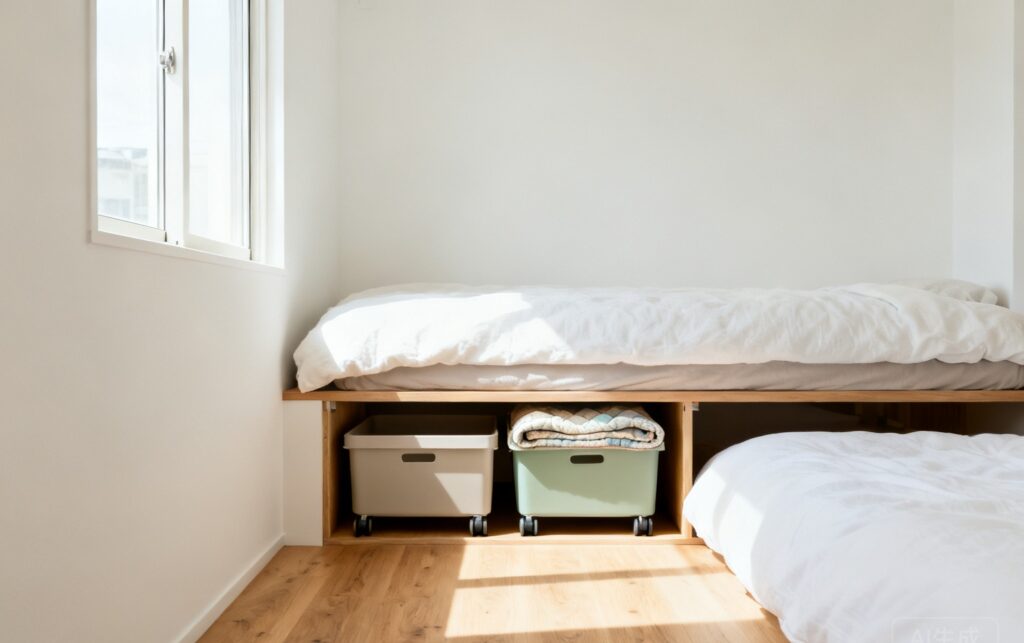
- 12+ inches: Rolling drawers with wheels or casters. This is the height where you get real pull-out access instead of dragging.
If you’re at 7.5 inches, buy for 7 inches. Never buy for the exact measurement. Frames flex, floors aren’t level, and carpet adds height you didn’t account for.
The Visibility Rule
Anything visible from the doorway changes how the room reads. A bed with six mismatched plastic bins underneath is a storage unit with a mattress on top. A bed with a fabric valance and nothing visible is a bedroom.
You have two options, and you should pick one deliberately.
Option one: hide everything. A bed skirt or valance that reaches the floor. This is the cheapest fix and the most effective. It works with any container you already own. Measure from the top of the box spring or mattress base to the floor, then buy a skirt at that drop length.
Option two: make it uniform. If you don’t want a skirt — and plenty of people don’t, because they collect dust and look dated on platform beds — then every container under the bed must match. Same type, same color, same orientation. Canvas totes in one color, all facing the same direction, read as intentional. Six different bins from six different purchases read as overflow.
Pick one container type. One color. Usually charcoal, natural canvas, or black. Then commit.
This is the same principle behind the vertical rule in small rooms: repetition looks designed, variety looks accidental.
The Access Rule
If using something under your bed requires lifting the mattress or pulling out four other things first, you’ll stop using it within a month. Not because you’re lazy — because friction compounds. The third time you have to unstack bins to reach the one in back, that bin becomes permanent furniture.
Prioritize anything that pulls out on its own:
- Rolling drawers with casters that slide out independently
- Beds with drawers built into the frame — these are the gold standard and worth the money if you’re buying a bed anyway
- Low-profile rolling carts you can pull out with one hand
Flat bags you have to drag across the floor are a compromise, not a solution. They work for things you genuinely touch twice a year. They fail for anything else.
If you’re already working with a foldable desk or a convertible setup, the same logic applies — see this foldable desk review for how pull-out access beats folding and unfolding every day.
What Actually Belongs Under a Bed
Good candidates:
- Seasonal clothing in vacuum bags or zippered totes
- Spare bedding and extra pillows
- Luggage — suitcases nest inside each other and take up otherwise dead space
- Off-season gear: ski layers, beach towels, holiday decorations
Bad candidates:
- Anything you need monthly. If it’s monthly, it needs a home at arm’s reach.
- Anything that produces heat — routers, electronics, chargers running constantly. Restricted airflow under a bed is a real problem.
- Anything that could mold. Leather, wool, paper photos, and untreated wood in a humid room will suffer.
One more: don’t store shoes you wear regularly under the bed unless they’re in a closed container. Dust settles, and under-bed airflow is worse than anywhere else in the room.
What to Buy
Four things cover almost every situation.
A set of matching under-bed storage bags with handles — buy these first if your clearance is under 10 inches. Get one color, one size, and buy more than you think you need so you never mix in a mismatched bin later.
Rolling under-bed drawers — the right call at 12+ inches of clearance. Look for locking casters and a lid that stays shut when you pull the drawer out. Cheap ones wobble and shed wheels within a year.
A bed riser set that adds 3–8 inches — read the opinion below before you buy.
A bed skirt or valance — measure your drop length first. A skirt that’s two inches too short looks worse than no skirt at all.
My honest take on bed risers
Risers work, with caveats. They’re the cheapest way to gain clearance, and 3–5 inches is often enough to move from “flat bags only” to “standard bins.”
What they break: bed stability. A riser raises the center of gravity and puts the load on four small cups instead of the frame’s full footprint. On a cheap metal frame, the bed will wobble. On a solid wood frame with a headboard bolted to the wall, you’ll barely notice.
They also fail on beds with center support legs. If your frame has a fifth leg in the middle touching the floor, risers on the four corners will lift the bed off that support and you’ll feel the mattress sag. Check before you buy.
And they look bad. Plastic risers under a visible frame read as a hack. Pair them with a skirt or buy a bed with drawers instead.
The Humidity Problem
This matters more than which container you pick.
Under-bed space has the worst airflow in the room. It’s enclosed on top, often against two walls, and blocked on the sides by whatever you’ve stored there. In a humid climate or a bedroom without good ventilation, that’s where mold starts.
Put a desiccant pack in every container. Silica gel packs are cheap and you can buy them in bulk. Rechargeable ones are better — you dry them in the oven or microwave and reuse them.
Check quarterly. Not annually. Open each container, feel the contents, look for damp spots or that musty smell. If you find moisture, the container isn’t the problem — the room is, and you need a dehumidifier before you store anything else down there.
Textiles are the first to go. Wool sweaters, down comforters, and anything cotton will grow mildew before you notice it. If your bedroom regularly sits above 60% humidity, don’t store fabric under the bed at all. Store hard goods — luggage, plastic bins of gear — and keep textiles somewhere with airflow.
If your room is small enough that under-bed storage is your only option, read how to make a studio apartment feel like two rooms for ways to free up storage elsewhere.