
Some links in this article are affiliate links. If you buy through them, we may earn a commission at no extra cost to you. How this works.
Count the materials in your living room. Not the objects — the materials. Wood, metal, glass, plastic, ceramic, fabric. Most people land on eight or more without trying. That number, not your clutter, is why the room feels loud.
The count is usually worse than people expect. A typical 11-by-13 living room lands on nine distinct materials without anyone buying anything new. Nothing in that room is clutter in the usual sense. The chaos is structural, not behavioral.
Disclosure: This post contains affiliate links. If you buy through them, we may earn a small commission at no extra cost to you. We recommend products based on published specifications, the volume of real-world reviews, and how well they fit the specific problem. We have not hands-on tested every item; where an article is based on direct use, it says so.
The Material Count Test
Walk the room. Every surface you touch or see gets a material label. Be specific — “metal” splits into brushed steel, matte black, chrome, brass. “Wood” splits into oak, walnut, painted MDF, laminate. Finish counts as a separate material because your eye reads it that way.
Here’s a typical small living room, scored honestly:
- Light oak floor (wood #1)
- Walnut coffee table (wood #2)
- IKEA Billy bookcase, white laminate (wood #3)
- Black metal lamp base (metal #1)
- Brushed steel floor lamp (metal #2)
- Glass side table top (glass)
- Ceramic planter (ceramic)
- Plastic storage bins under the sofa (plastic)
- Cotton sofa in oatmeal, linen curtains in cream, acrylic throw (fabric #1, #2, #3)
That’s twelve. Twelve materials in one room, and every one of them is fighting for attention. The eye can’t settle because it never gets to rest on a repeated note.
Now a calm version of the same room:
- Light oak floor
- Light oak coffee table
- Light oak shelving
- White ceramic lamp base, white ceramic planter, white ceramic tray
- Off-white cotton sofa, off-white linen curtains, off-white wool throw (all read as one neutral)
Two materials plus a neutral. Same square footage. Same number of objects, roughly. Completely different room.
Why This Works
Your visual system groups by similarity. Three oak pieces become one oak “unit” in your perception, not three separate objects competing for attention. Three different wood tones become three separate objects, because your brain has to process each one as a new thing.
This is why hotel rooms feel calm. It isn’t the cleaning staff. It’s that the headboard, nightstands, desk, and wardrobe are all the same laminate in the same finish. Your brain processes the whole room as maybe four visual units instead of thirty.
It’s also why photos of well-designed small apartments look effortless. Look closely at the ones you save to Pinterest. Count the materials. Most of them are running two, maybe three. The rooms don’t look sparse — they look intentional, because the eye has somewhere to rest.
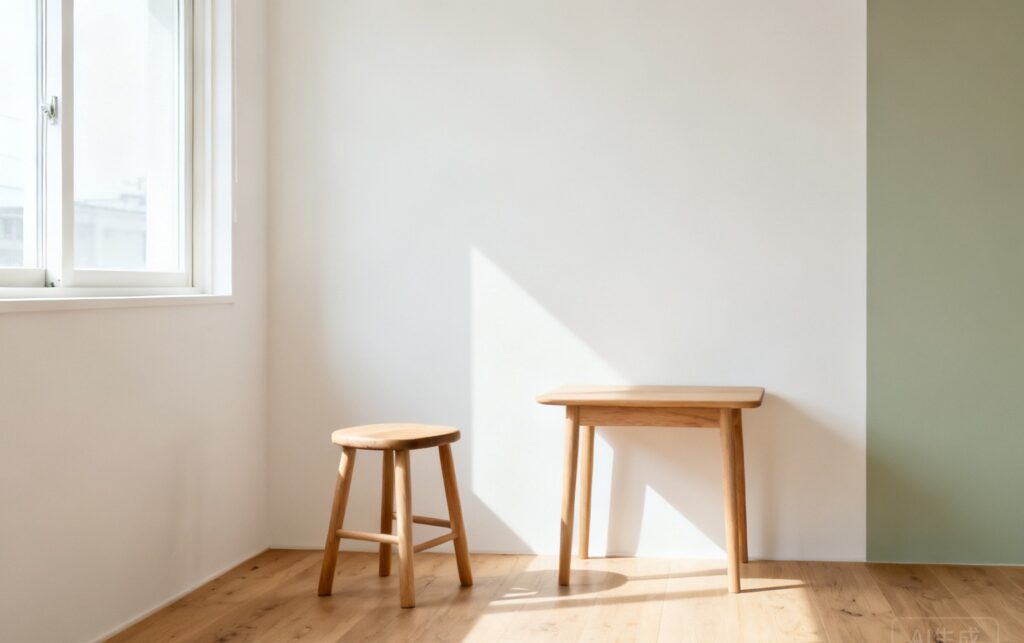
Material consistency is the single highest-leverage move in making a small room feel bigger, and it costs nothing.
How to Choose Your Two
You don’t get to pick in a vacuum. Most rooms have fixed elements — the floor, kitchen cabinets, window frames, radiator covers, tile. Those aren’t moving. So your first material should match or complement the dominant fixed material in the room.
If your floor is light oak, oak is your first material. If your rental kitchen has white laminate cabinets and you’re doing the adjacent living space, white is your first. If your windows are black-framed aluminum, black metal is your first — that’s a gift, because black metal pairs with almost anything warm.
Your second material is the contrast. It should be visually distinct from the first, not a near-miss. Oak and walnut are not two materials — they’re one material with a mistake. Oak and white ceramic are two materials. Oak and matte black metal are two materials. Oak and medium-gray fabric is one material, badly matched.
Pairs that reliably work:
- Light wood + white ceramic
- Dark metal + natural linen
- Black metal + warm wood
- Walnut + cream wool
- Pale oak + matte black
Pick one. Commit. The commitment is the whole point.
Doing It Without Buying Anything
Here’s the part that makes this an anti-consumption rule instead of a shopping list. Nine times out of ten, the object introducing your third, fourth, or fifth material is fine. It just belongs in a different room.
Concrete relocations from a typical studio:
- Chrome desk lamp from the living room → moved to the bathroom. Chrome fits against tile and glass; it doesn’t fit against oak and linen.
- Plastic storage bins under the sofa → moved to the closet. Nobody sees them, and they’re doing real work there.
- Glass side table → moved to the entryway, where the glass reads as intentional against a white wall.
- Black metal floor lamp → moved to the bedroom, which was already running black metal and walnut.
Not one of those objects was wrong. They were in the wrong room. Walk your apartment with the material count in your head and start swapping. This is also the move that makes a studio apartment feel like two rooms — different material palettes in different zones create psychological separation without a single wall.
If you have a foldable desk or any multi-use furniture, check its finish against the room it lives in before you check anything else. A foldable desk review is worth reading for the ergonomics, but the finish is what determines whether it disappears into the room or fights it.
What to Buy
You probably don’t need to buy anything. If you do, buy one thing at a time, and only to reinforce a material you’ve already committed to.
The three purchases that actually move the needle:
- Matching natural-fiber storage baskets in a single tone. Three sizes, one weave, one color. They replace the plastic bins, the mismatched canvas totes, and the cardboard box you’ve been ignoring since March.
- A single-material set of picture frames. All black, or all natural oak, or all thin brass. Not a mix. The frames are usually the biggest hidden material offender in a living room.
- One accent material item. A single ceramic vase, a single brass bowl, one linen throw in a tone that reads as a third material. One. Not three. This is the piece that keeps the room from looking like a showroom.
That’s it. Three items, and most people need zero of them.
When to Break the Rule
Two honest exceptions.
Kitchens. A kitchen has ceramic, stone, metal, wood, glass, and plastic by function. You cannot run a two-material kitchen and still cook. Accept it, and instead aim for two materials in the visible surfaces — usually cabinet finish plus countertop — and let the small appliances hide in a cabinet.
Kids’ rooms. Plastic toys, fabric soft goods, wooden blocks, painted furniture. The material count is going to be high no matter what you do, and fighting it will make you miserable. Instead, run the two-material rule on the storage and the furniture, and let the contents be loud. The room will still read as calm when the toys are put away.
And one deliberate break: a single accent material used in exactly one place. One brass lamp in a black-and-oak room. One terracotta pot on a white-and-wood shelf. The rule only works because you’re allowed to break it once. Break it twice and you’re back to nine materials and a room that won’t sit still.
Count your materials tonight. You’ll know within five minutes whether your room is at two or at eleven, and you’ll know exactly which objects to move.